
Sandy Soils: Where Cement Fails, Polymer Succeeds
Adapted from Bob Vitale, founder and CEO of Midwest Industrial Supply, Inc.
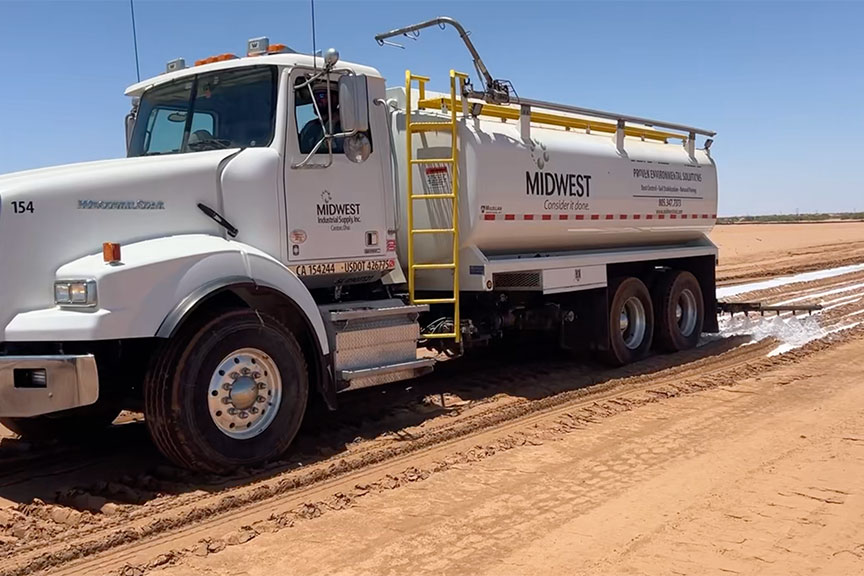
On a major solar project of more than 400 hectares in New Mexico, the engineering team encountered a familiar problem: cement stabilization was not delivering reliable results. The soils, fine A-3 sands, had a CBR of just 2.
Why Cement Does Not Work on These Soils
The reaction that sets cement needs clay particles, which are absent from A-3 sands. Their uniform particle size also prevents an interlocking structure from forming: cement coats the grains without strengthening the soil. Even with Portland cement dosages of 3 to 8%, test sections did not consistently reach the required CBR of 30, and each failure delayed construction.
Switching to Polymer
With Midwest's Soil-Sement® Engineered Formula, CBR rose from 2 to 35, an improvement of 1,650%. All sections met the specifications, with results verified by an independent laboratory. The project stabilized approximately 27 km of access roads and 6.5 hectares of storage areas in 21 days.
How It Works
The polymer relies neither on clay nor on a chemical reaction with the soil: it coats and binds each grain to form a dense, uniform layer. Laboratory results therefore carry through to the field. The treatment uses only in-place soils and does not leach.
When to Choose a Polymer
A CBR below 5, uniform particle size or a low plasticity index (PI < 10) are good indicators, as are tight schedules, heavy traffic or a history of failures with conventional methods.
To go further, see polymer soil stabilization, the NaturalPave system for unpaved roads and the village road stabilized in Senegal.